High-Speed FPV Drone
Designing an 8S FPV drone around a 245 mm frame and a 710 g mass budget, balancing propulsion, packaging, and aerodynamic constraints. Build and flight testing are in progress.
Why I changed the first design
I started with a seven-inch, 6S concept. After working through the propulsion and drag tradeoffs, I moved to a smaller-propeller 8S layout. That reset gave me a better starting point for the aircraft instead of committing to the first idea because I’d already spent time on it.
The current layout
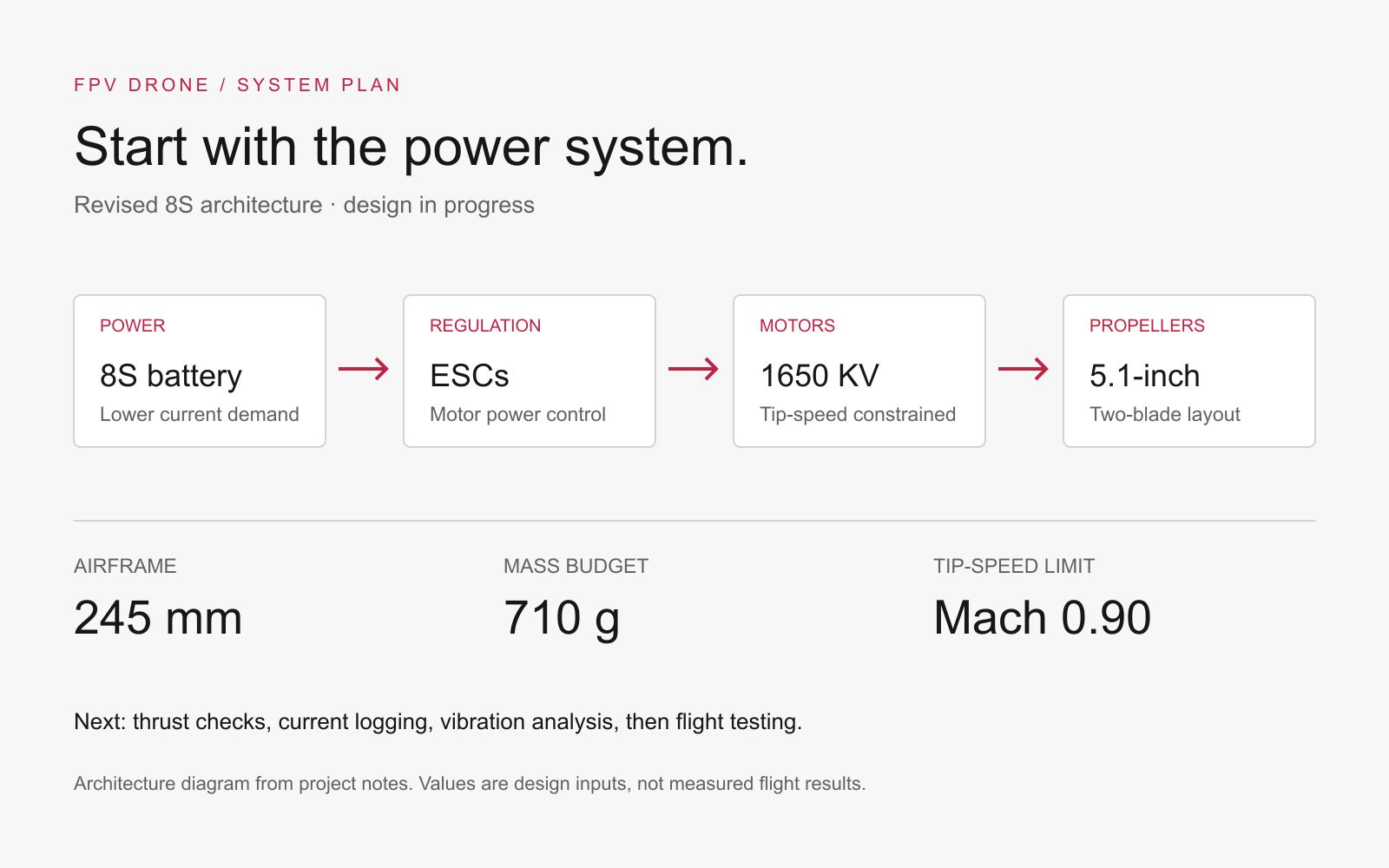
I’m designing around a 245 mm frame, 5.1-inch two-blade props, and a 710 g mass budget. The bodywork concept uses an ogive PA-CF fuselage, ducted motor nacelles, and an enclosed electronics bay. I’m working through the packaging and drag choices together.
I selected 1650 KV motors with a propeller-tip limit near Mach 0.90 at charged voltage. Moving to 8S lowers the current needed for a given power level; my comparison estimates 44% lower resistive loss than the earlier 6S arrangement.
What comes next
The flight stack plan uses Betaflight, ELRS, GPS, and Blackbox telemetry. I’ll start with component and static-thrust checks, then use current, vibration, and motor-temperature logs to guide tuning before speed testing.
The diagram is the system plan I’m working from as I move toward fabrication and testing.
Result
The current design uses a 245 mm frame, 8S power, and 5.1-inch two-blade props within a 710 g mass budget. Fabrication and flight testing are still ahead.
What I learned
Be willing to restart the design when the numbers don’t support it. I’d rather change the architecture in CAD than discover the problem after building it.
Project context
This is a design in progress. The 710 g budget and Mach 0.90 tip limit are design targets; the 44% resistive-loss reduction is a calculation, not a flight measurement.
Mechanical engineering, robotics, software, and applied AI internships